Article
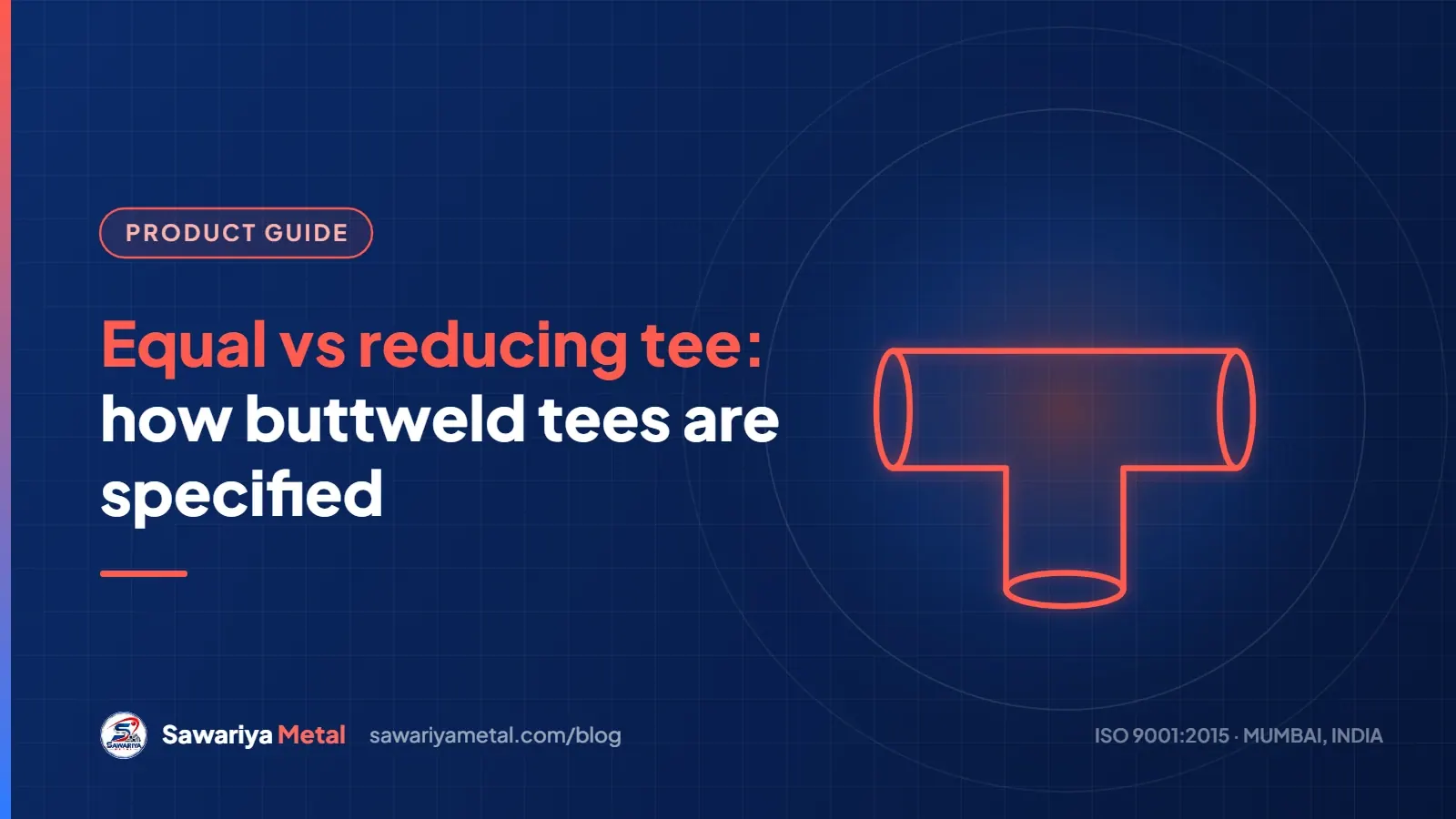
A tee splits one flow into two or brings two flows together. It is the standard way to take a branch from a main line when the branch is large enough that a weldolet or a stub-in connection is not suitable. Tees come in two families, equal and reducing, and most quoting mistakes come from how the sizes are written.
Equal (straight) tee
In an equal tee all three ends are the same nominal size, for example 6" × 6" × 6". It is used where the branch needs the same capacity as the main run, such as a header splitting into two equal lines.
Reducing tee
In a reducing tee the branch is smaller than the run, for example 6" × 6" × 4". The first two figures are the run ends and the third is the branch. A reducing tee is cleaner and stronger than an equal tee followed by a reducer, and it saves one weld.
| Description | Run | Branch | Type |
|---|---|---|---|
| 4" × 4" × 4" | 4" | 4" | Equal tee |
| 8" × 8" × 6" | 8" | 6" | Reducing tee |
| 8" × 6" × 4" | 8" and 6" | 4" | Reducing on run and branch (special) |
Tees that reduce on the run as well as the branch are not covered by standard B16.9 tables and are usually treated as special items with longer delivery.
How tees are made
- Seamless tees are hot formed from seamless pipe by hydraulic bulging or extrusion of the branch. They suit high pressure and critical service.
- Welded tees are formed from welded pipe or plate. In ASTM A403 they carry the WP-W or WP-WX marking depending on the extent of radiography.
- Fabricated tees are made by cutting a hole in a pipe and welding on a branch. They are cheaper but are not equivalent to a forged or formed B16.9 tee and need separate design approval.
Dimensions and wall thickness
ASME B16.9 fixes the centre-to-end dimension of the run (C) and the branch (M). For an equal tee both are the same; for a reducing tee the branch dimension is slightly shorter. The wall thickness at the ends must match the connecting pipe schedule. When the run and branch pipes have different schedules, state both, for example 8" SCH 40S × 6" SCH 80S.
Where tees are used
- Headers and manifolds in process plants
- Cooling water, fire water and utility distribution
- Instrument and drain take-offs on larger lines (reducing tees)
- Bypass arrangements around control valves
A complete tee description
Reducing Tee 8" × 8" × 6", SCH 40S, ASTM A403 WP304L-S, ASME B16.9, bevelled ends – 12 nos
Frequently asked questions
How do you read the size of a reducing tee?
The first two sizes are the run ends and the last size is the branch. 6" × 6" × 4" means a 6" run with a 4" branch.
Is a reducing tee better than a tee plus a reducer?
Usually yes. It removes one weld, shortens the assembly and gives a smoother flow path.
What standard covers buttweld tees?
ASME B16.9 covers dimensions and tolerances. Material is covered by ASTM A403 for stainless steel and ASTM A234 for carbon and alloy steel.
Key takeaways
- Equal tees have three ends of the same size; reducing tees have a smaller branch.
- Write the size as run × run × branch.
- State the schedule of both run and branch if they differ.
Need these products?
Sawariya Metal Industries supplies stainless steel pipes, flanges and buttweld pipe fittings from Mumbai to buyers in India and overseas. Send your size, grade, standard and quantity through our enquiry form and we will reply with a clear quotation and the test documents you need. You can also browse our stainless steel pipes, flanges and buttweld fittings.