Article
A reducer joins two pipes of different sizes. It looks like a simple fitting, but the choice between a concentric and an eccentric reducer affects how a line drains, vents and feeds a pump. Getting it wrong can cause air pockets, cavitation and trapped liquid.
Concentric reducer
A concentric reducer has both ends on the same centre-line, like a cone. The flow is symmetric, so it is the natural choice for vertical lines and for gas or steam lines where trapped liquid or vapour is not an issue.
Eccentric reducer
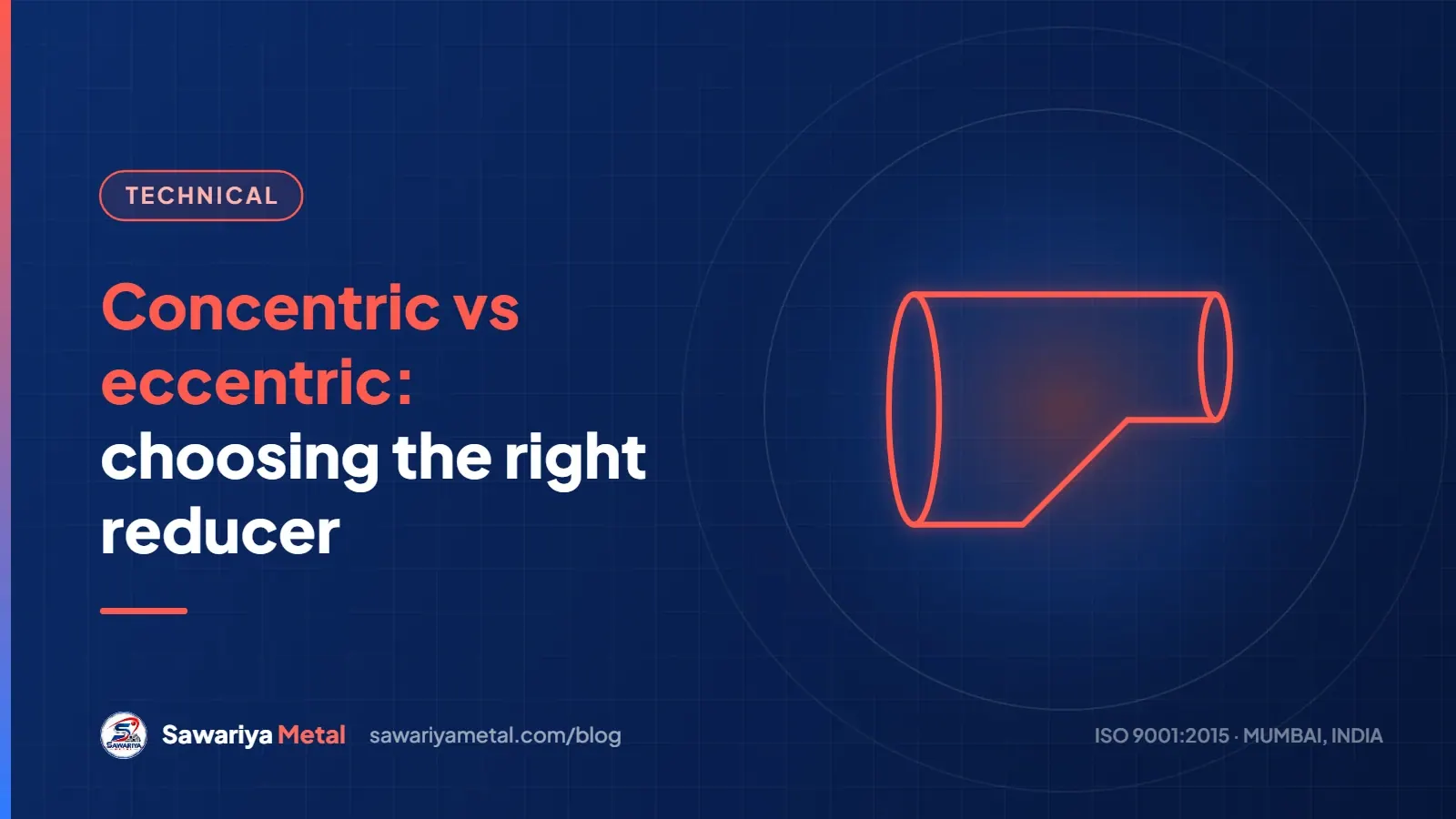
An eccentric reducer has one side flat, so the centre-lines of the two ends are offset. Keeping one side level allows a horizontal line to stay level at its top or bottom across the size change.
| Feature | Concentric | Eccentric |
|---|---|---|
| Centre-lines | Same | Offset |
| Typical orientation | Vertical lines | Horizontal lines |
| Main use | Pump discharge, gas and steam | Pump suction, pipe racks, drainable lines |
| Air or liquid traps | Possible in horizontal runs | Avoided by choosing flat side up or down |
Flat on top or flat on bottom?
- Flat on top (FOT) – used on pump suction lines. A pocket at the top of the reducer would collect air or vapour, which can then be drawn into the pump and cause cavitation. With the flat side up, gas can travel freely.
- Flat on bottom (FOB) – used on pipe racks so that the bottom of pipe stays at one elevation for supports, and on lines that must drain fully.
Dimensions
ASME B16.9 sets the overall length (H) for each combination of sizes. Concentric and eccentric reducers of the same size have the same length. Standard reductions usually go down about two to three sizes; larger reductions may need two reducers or a special fitting.
Wall thickness at each end
Each end should match its own pipe. If the large pipe is SCH 10S and the small pipe is SCH 40S, write that clearly, for example 6" SCH 10S × 3" SCH 40S. A supplier cannot assume it.
A complete reducer description
Eccentric Reducer 6" × 4", SCH 40S, ASTM A403 WP316L-W, ASME B16.9, bevelled ends – 20 nos
Frequently asked questions
Why is an eccentric reducer used on pump suction?
With the flat side on top it prevents an air or vapour pocket forming in the reducer, which could otherwise enter the pump and cause cavitation.
Do concentric and eccentric reducers have the same length?
Yes. ASME B16.9 gives the same end-to-end length for both types of the same size combination.
Can a reducer have different schedules at each end?
Yes. It is common, but both schedules must be stated in the enquiry.
Key takeaways
- Concentric for vertical and gas lines; eccentric for horizontal liquid lines.
- Pump suction: eccentric, flat on top.
- Pipe racks and drainable lines: eccentric, flat on bottom.
Need these products?
Sawariya Metal Industries supplies stainless steel pipes, flanges and buttweld pipe fittings from Mumbai to buyers in India and overseas. Send your size, grade, standard and quantity through our enquiry form and we will reply with a clear quotation and the test documents you need. You can also browse our stainless steel pipes, flanges and buttweld fittings.